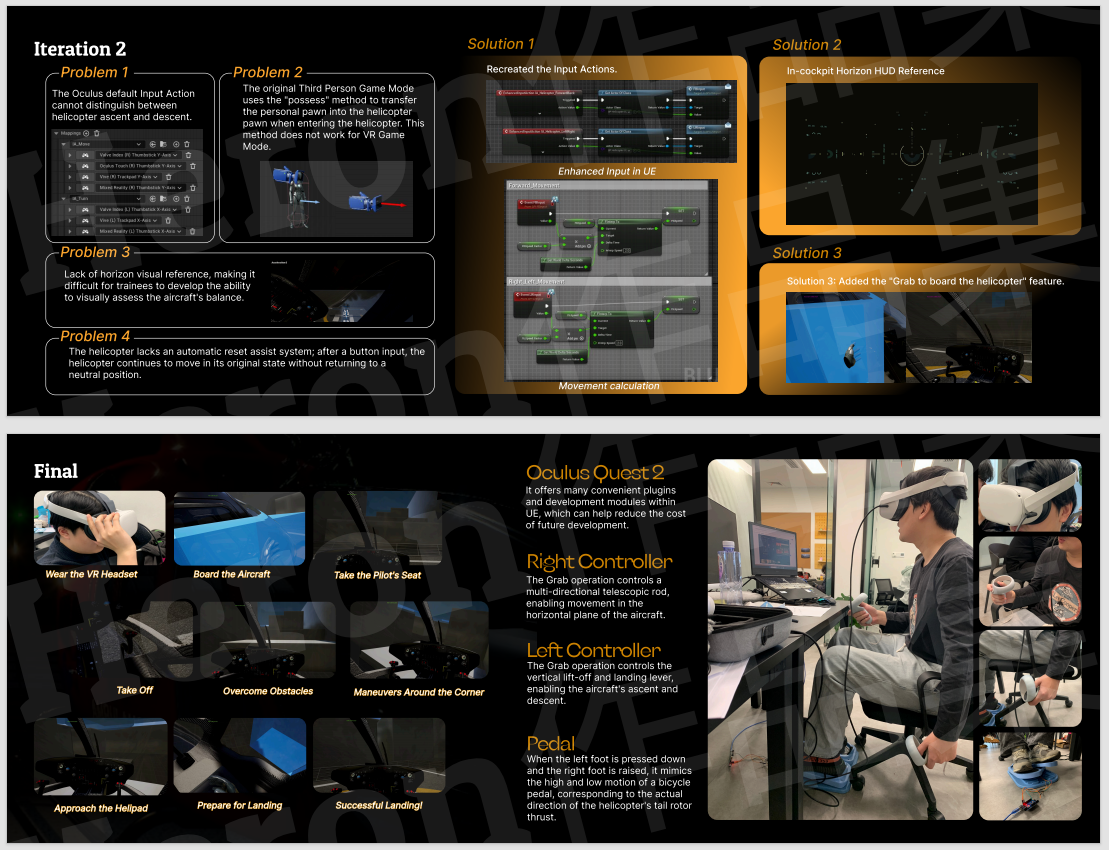
Helicopter Simulation
A VR serious game for training novice helicopter pilots: an Oculus Quest virtual training system, a custom sensor-equipped tail-rotor pedal rig, and a cockpit horizon reference.
Role
Product Designer / Systems Developer (solo)
Engine
UE5 + Meta Quest + Arduino
Team
Individual project
Duration
Dec 2024
Background & Pain Points
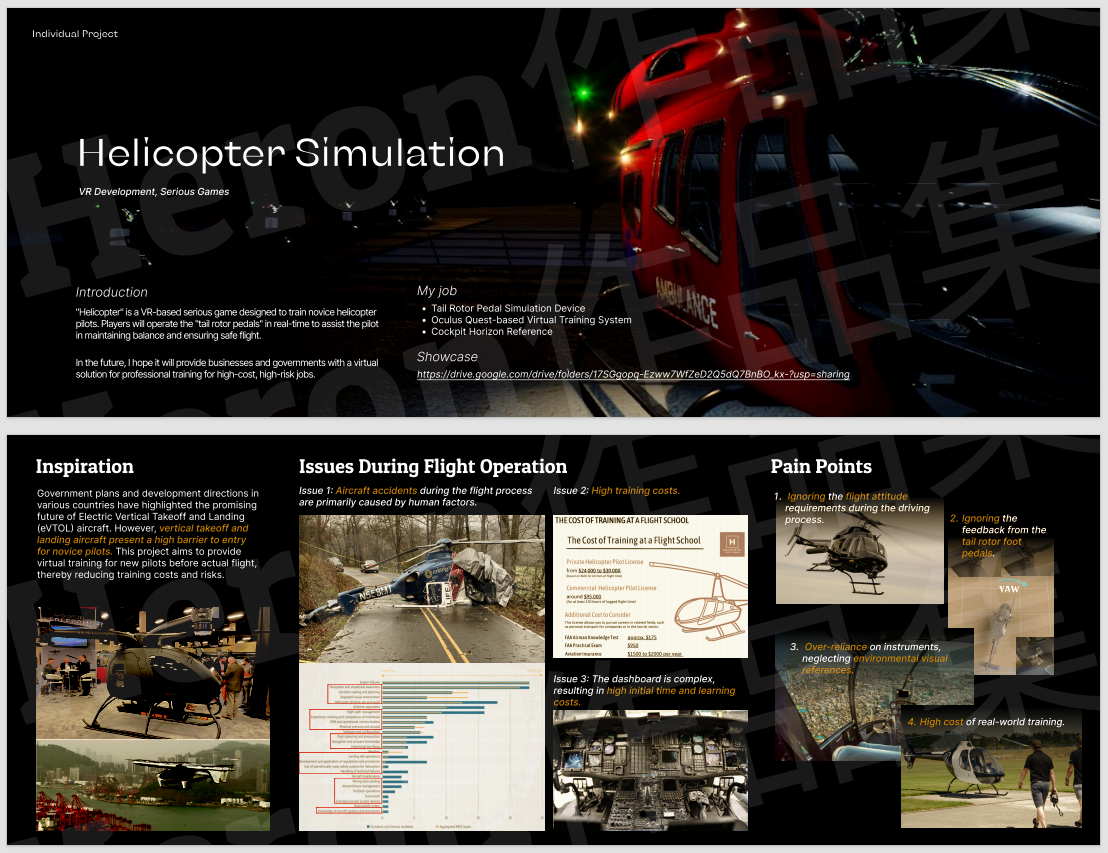
Government plans across many countries point to a promising future for eVTOL aircraft, yet vertical takeoff and landing aircraft present a high barrier to entry for novice pilots. Targeting three pain points — flight accidents primarily caused by human factors, high real-world training costs, and complex dashboards with steep learning curves — this project provides virtual training before actual flight, reducing cost and risk.
Research surfaced two further issues: over-reliance on instruments while neglecting environmental visual references, and existing solutions ignoring feedback from the tail-rotor foot pedals.
Design Solution
- VR training system: built on Oculus Quest, enabling training in any safe location, anytime
- Sensor foot pedals: simulate real helicopter pedals — pressing one lifts the other, controlling the tail rotor in real time to adjust heading
- Training process: applies the learning-curve mechanism from game design, structuring modules in blocks — "introduction to controls → simple single-action training → complex single-action training → mixed action training", mapped to hovering, climbing, sideways/yaw, and comprehensive scenario levels
Hardware: Custom Pedal Rig
An MPU6050 sensor (with built-in gyroscope) is connected to an Arduino and mounted at the center of the pedal crossbar; monitoring changes in the sensor's gravity acceleration components determines the pedal's tilt angle. Program logic: sensor reads pedal tilt → converted into YawInput in UE → yaw calculation → resulting yaw angular velocity applied to the helicopter.
Two Iterations
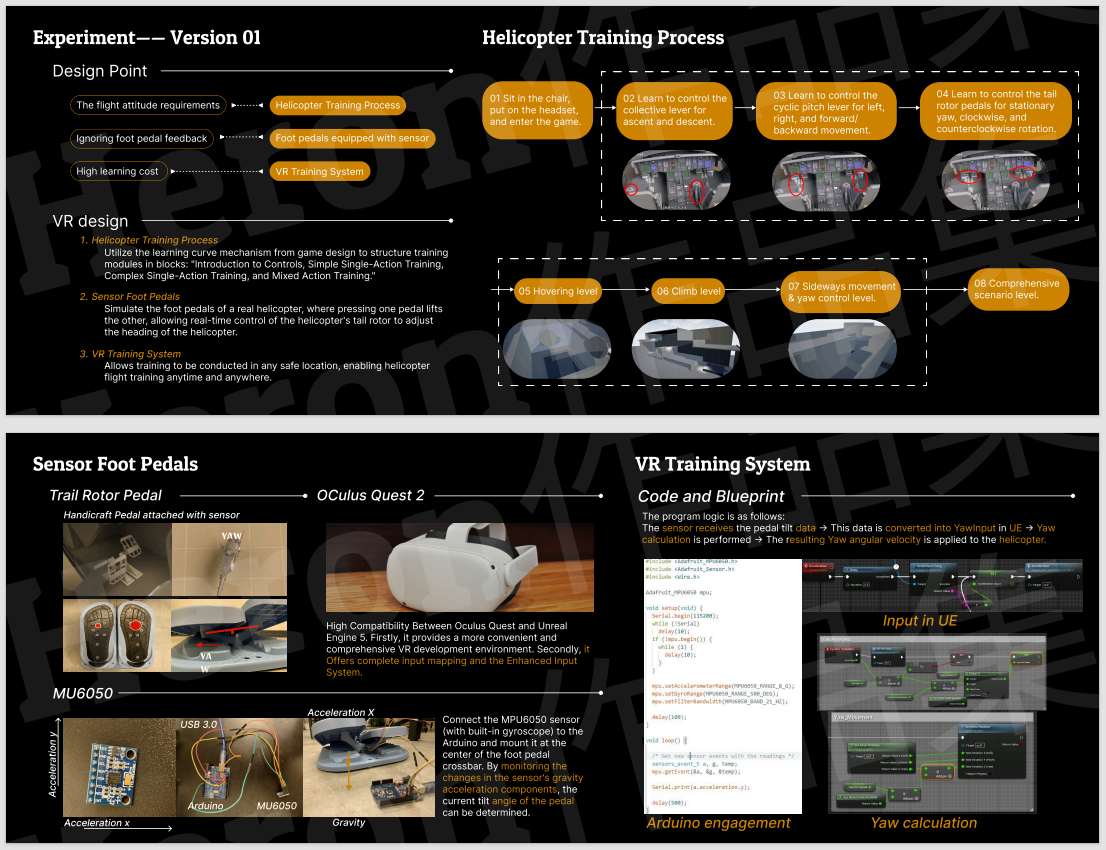
Version 1 — problems & solutions:
- Player's view didn't rotate with the helicopter → SpringArm component for realistic camera rotation
- Sensor too sensitive with no balanced state (acceleration fluctuating within ±2) → dead zone of 0.5; max turning speed reached at 2
- No levels guiding operational training → built a training level blockout
Version 2 — problems & solutions:
- Oculus default Input Actions couldn't distinguish ascent from descent → recreated Input Actions with Enhanced Input
- The third-person "possess" boarding method fails in VR Game Mode → added a "grab to board" interaction
- No horizon reference made visual balance judgment difficult → in-cockpit horizon HUD
- Helicopter didn't return to neutral after input → automatic reset assist
Final Build
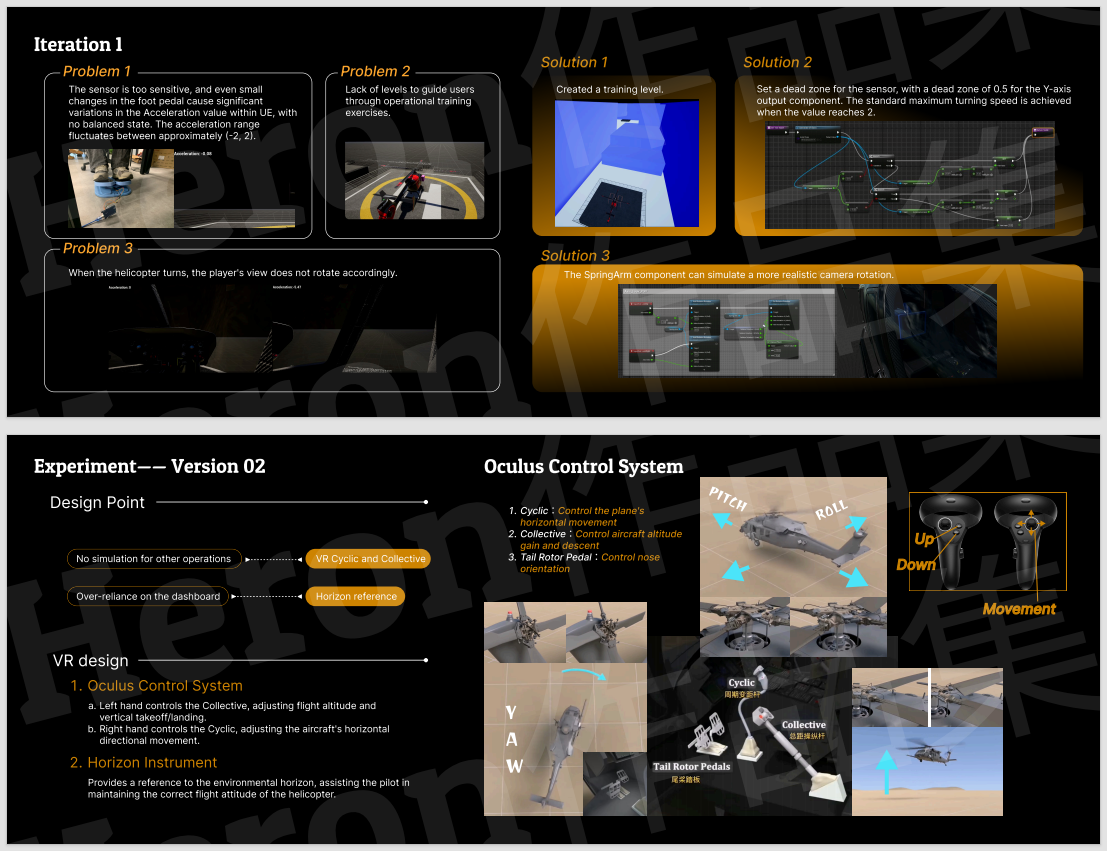
A three-controller input scheme: the left grab controls the collective (vertical lift-off/landing lever), the right grab controls a multi-directional telescopic cyclic rod (horizontal movement), and the pedals mimic bicycle-pedal motion matching real tail-rotor thrust direction. Full flow: wear the headset → interact with the door to board → take the pilot's seat → take off → climb over obstacles → maneuver around corners → approach the helipad → land successfully.